Concrete is one of the few parts of a home or outdoor project that is difficult, disruptive, and expensive to redo. A driveway that drains toward the garage, a patio that cracks too early, or a shop slab that was not prepared for the load it carries can create problems long after the crew has left.
Choosing the right concrete contractor in Tulsa is not just about finding the lowest bid. It is about finding a contractor who understands local soil, drainage, reinforcement, scheduling, permits, and the way your slab fits into the bigger project. Whether you are planning a patio, driveway, garage floor, metal building pad, barndominium foundation, or outdoor kitchen area, the right decision starts with asking better questions.
Start with the exact type of concrete work you need
Before you compare contractors, define the job as clearly as possible. Concrete contractors often have different strengths. Some focus mainly on small flatwork. Others are better suited for structural foundations, agricultural buildings, shop slabs, or turn-key construction where concrete must coordinate with framing, utilities, grading, and finish work.
A good scope should include the location, intended use, approximate size, access conditions, drainage concerns, desired finish, and whether the concrete will support vehicles, equipment, walls, posts, or a full building. If the project is part of a larger build, such as a barndominium or metal building, the concrete contractor should understand how the slab interacts with the structure above it.
| Project type | Why the contractor fit matters | What to ask |
|---|---|---|
| Driveway | Must handle vehicle loads and water runoff | How will the base, slope, and joints be handled? |
| Patio | Needs proper drainage, finish quality, and clean edges | What finish options work best for outdoor use? |
| Garage or shop slab | Often supports vehicles, tools, lifts, or equipment | What reinforcement and thickness are appropriate for the use? |
| Barndominium foundation | Must coordinate with building plans and engineering | How will the slab, footings, anchor points, and framing requirements align? |
| Outdoor kitchen area | May need coordination with utilities, posts, roof structures, and drainage | Who coordinates the concrete with the rest of the outdoor living build? |
Being specific protects you from vague bids. A contractor who cannot explain how the slab will be built for your intended use may not be the right fit.
Look for Tulsa-specific experience
Tulsa concrete work has its own challenges. Local projects often deal with clay-heavy soils, heavy rains, hot summers, freeze and thaw cycles, and yard elevations that can create drainage issues. These conditions do not make concrete a bad choice. They simply make preparation and workmanship more important.
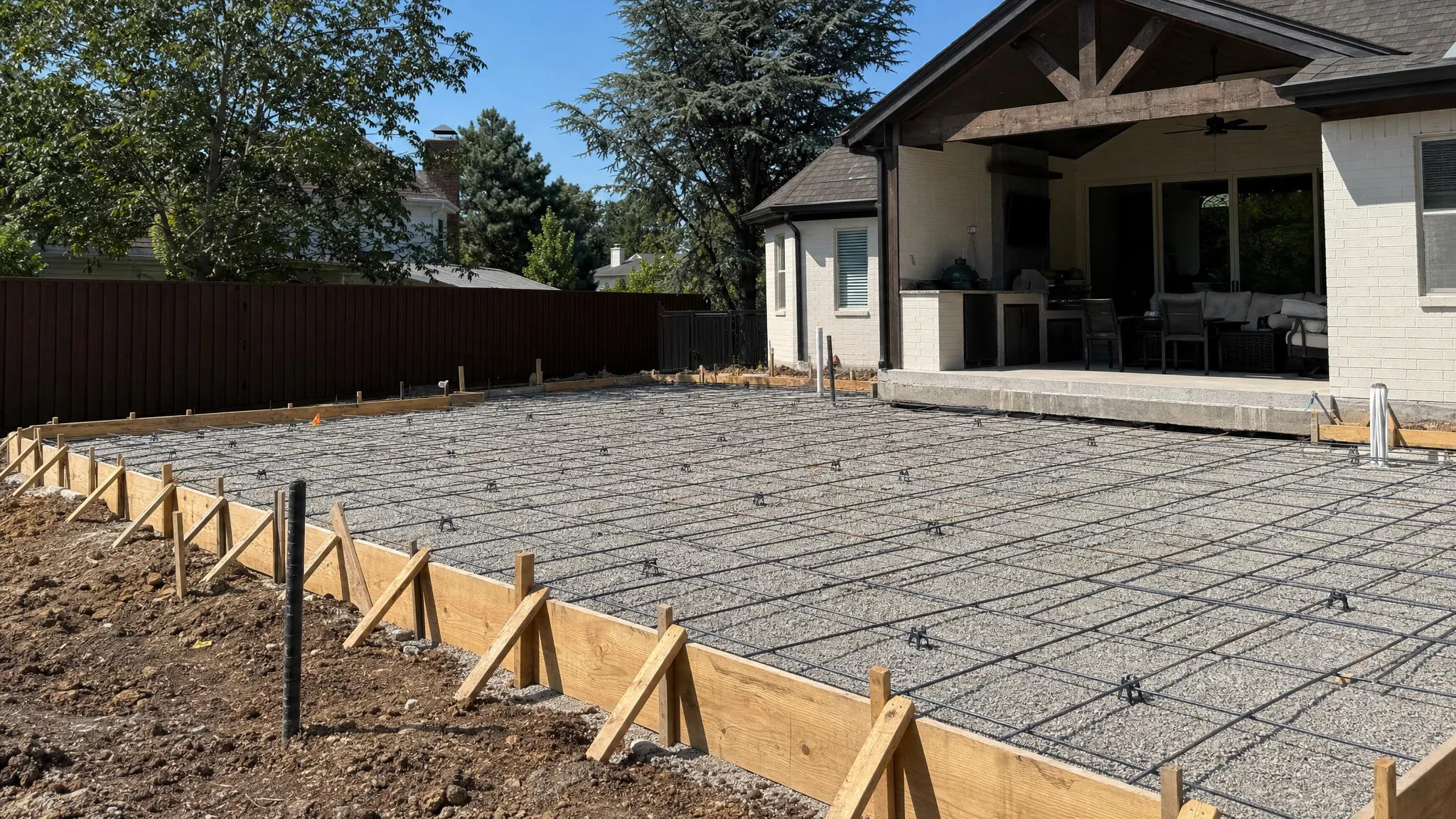
A qualified concrete contractor should talk about subgrade preparation before talking about the pour itself. The base under the slab, the way water leaves the area, the compaction of the soil, and the placement of forms all influence the finished result. Even the best concrete mix can perform poorly if it is poured over an unstable or poorly drained base.
If your project is outdoors, ask the contractor how water will move after the slab is installed. Concrete should not trap water against a house, slope runoff toward a door, or create a low spot that stays wet after every storm. For homeowners planning a patio, the same site-prep principles discussed in Summit's guide to preparing a backyard for a concrete patio are useful reminders for any exterior concrete project.
Verify insurance, permits, and accountability
A professional concrete contractor should be able to show proof of insurance and explain who is responsible for the jobsite. At a minimum, ask for current general liability coverage. If the company has employees, ask about workers compensation coverage as well. Insurance is not a sign of quality by itself, but it is a basic layer of protection for you and the crew.
Permitting can vary depending on the type and location of the work. A simple backyard slab may be different from a driveway approach, structural foundation, addition, or project that affects utilities, drainage, easements, or public right of way. For city projects, it is smart to verify requirements through City of Tulsa Development Services permit resources or ask the contractor to explain what is required for your address.
Be cautious with anyone who gives a fast answer without seeing the site or reviewing the larger scope. Responsible contractors know that details matter. They should also provide a written estimate, a clear payment structure, and a named point of contact. If you are still early in the hiring process, Summit's broader advice on shopping for a contractor can help you compare options before schedules fill up.
Compare estimates by scope, not just price
Concrete bids can look very different even when they appear to describe the same project. One contractor may include excavation, gravel base, rebar, cleanup, and control joints. Another may quote only the pour and finish. If you choose by the bottom-line number alone, you may miss important differences that affect durability.
Ask each contractor to break down what is included. You do not need a complicated engineering document for every patio or driveway, but you do need enough detail to know what you are buying.
| Estimate detail | Why it matters | Good question to ask |
|---|---|---|
| Excavation and grading | Determines whether the slab has proper depth and drainage | Is site prep included in the price? |
| Base material | Helps stabilize the slab and manage moisture | What base will be used under the concrete? |
| Concrete thickness | Must match the intended load and use | What thickness do you recommend for this project and why? |
| Reinforcement | Helps manage movement and load demands | Will you use rebar, wire mesh, fiber, or another reinforcement method? |
| Control joints | Encourages cracking to occur in planned locations | Where will joints be placed and how soon? |
| Finish and sealer | Affects appearance, traction, and weather exposure | What finish is best for outdoor use in Tulsa? |
| Cleanup and access repair | Prevents surprises after the crew leaves | Is cleanup, haul-off, and yard protection included? |
Ask about materials, reinforcement, joints, and curing
A trustworthy contractor does not need to overwhelm you with technical language, but they should be able to explain the basics. Concrete performance depends on the right mix, a prepared base, reinforcement where appropriate, joint planning, proper placement, finishing skill, and curing conditions.
The American Concrete Institute is one of the leading sources for concrete standards and education, and its guidance reinforces a simple truth: concrete quality is a system, not a single product. The truck may deliver the mix, but the contractor controls many of the field conditions that determine how the slab performs.
Pay attention to how the contractor talks about these topics:
- Concrete mix: The contractor should choose a mix suited to the project, exposure, and load, not just whatever is cheapest that day.
- Reinforcement: Rebar, wire mesh, or fiber may be recommended depending on the slab, but the contractor should explain the reason rather than using vague promises.
- Control joints: Concrete commonly cracks as it shrinks, so planned joints help guide cracking in a cleaner, more controlled way.
- Finishing: Outdoor concrete needs a finish that balances appearance with traction, especially around patios, walks, and pool-adjacent spaces.
- Curing: Proper curing helps concrete gain strength and reduces avoidable surface problems, especially during hot, dry, or windy conditions.
If a contractor says concrete never cracks, that is a red flag. A better answer is that good design, preparation, reinforcement, joint placement, and curing help manage cracking and reduce unnecessary failures.
Evaluate the contractor's process from site visit to final walkthrough
The best contractors usually have a repeatable process. They do not simply show up, pour, and disappear. They inspect the site, confirm access, discuss drainage, set expectations, coordinate the pour, supervise the crew, and review the finished work.
During the estimate, notice whether the contractor measures carefully, checks elevations, asks how the space will be used, and identifies obstacles such as gates, fences, slopes, utilities, irrigation lines, tree roots, or existing concrete. These details affect time, equipment, labor, and the finished result.
A professional process should usually include an on-site review, written scope, schedule estimate, site preparation plan, form inspection before the pour, crew supervision during placement, finishing plan, curing guidance, cleanup, and a final walkthrough. If the contractor skips straight to a price without discussing any of that, the bid may not be as complete as it appears.
Review past work with a critical eye
Photos and reviews are helpful, but you should look beyond the surface. Fresh concrete often looks good in pictures. The more important question is how the work performed after rain, heat, use, and time.
Ask to see projects that are similar to yours. A beautiful stamped patio does not prove that the same contractor is the best choice for a shop slab. A driveway portfolio does not automatically prove experience with barndominium foundations. Similarity matters.
When speaking with references, ask practical questions. Did the crew arrive when expected? Did they protect the property? Was the project completed close to the quoted price? Did water drain properly afterward? Did the contractor respond if there was a concern? These answers reveal more than star ratings alone.
Online reviews can also help you identify patterns. One unhappy review is not always a deal breaker, but repeated complaints about communication, missed schedules, messy jobsites, or surprise charges deserve attention.
Watch for red flags before you sign
Some warning signs are obvious. Others are subtle. If you notice several of them at once, keep looking.
| Red flag | Why it matters | Better standard |
|---|---|---|
| No written estimate | Verbal agreements are easy to misunderstand | Get scope, price, and terms in writing |
| Unclear insurance status | You may carry more risk than you realize | Ask for current proof of coverage |
| Pressure to decide immediately | Good contractors explain, not pressure | Take time to compare details |
| Vague site-prep plan | Poor base preparation can shorten slab life | Ask how excavation, grading, and compaction will be handled |
| No discussion of drainage | Water problems can damage surrounding areas | Confirm slope and runoff before work starts |
| Very low bid with missing details | The price may exclude important steps | Compare line items, not just totals |
| No clear project supervisor | Accountability can disappear on pour day | Know who manages the crew onsite |
The goal is not to find the most expensive contractor. The goal is to find the contractor whose price matches a complete, realistic, and well-managed scope.
Match the contractor to the bigger project
Concrete often connects to other parts of construction. A patio may become the base for a pergola or outdoor kitchen. A shop slab may need to align with a metal building frame. A barndominium foundation must follow the design and structural requirements of the building.
This is where a turn-key general contractor can offer an advantage. When the same team understands the design, foundation work, building shell, and finish-out, there is less room for miscommunication between trades. Summit Barndominiums & Outdoor Living provides concrete and foundation work along with custom barndominiums, metal buildings, garages, carports, workshops, sheds, outdoor kitchens, pergolas, patios, room additions, and site design across the Tulsa area.
If your concrete project is part of a larger residential, agricultural, or outdoor living build, choosing a contractor who can coordinate the full scope may save time and reduce risk.
Final checklist for choosing a concrete contractor in Tulsa
Before you hire, make sure you can answer these questions with confidence:
- Does the contractor have experience with my specific type of concrete project?
- Did they inspect the site in person before giving a final estimate?
- Can they explain drainage, base preparation, reinforcement, joints, and curing?
- Is the scope written clearly enough to compare against other bids?
- Have I verified insurance and discussed any permit requirements?
- Do their reviews and references show reliable communication and workmanship?
- Do I know who will supervise the job on pour day?
- Does the contractor understand how the concrete fits into the rest of my project?
If the answer is yes across the board, you are much closer to choosing the right contractor. If several answers are unclear, ask follow-up questions before signing.
Frequently Asked Questions
How much should I rely on price when choosing a concrete contractor in Tulsa? Price matters, but it should not be the only factor. A lower bid may exclude site prep, reinforcement, cleanup, or proper drainage planning. Compare the full scope before deciding.
Should a concrete contractor visit my property before giving a quote? For most projects, yes. Site conditions such as slope, access, soil, drainage, existing concrete, and nearby structures can affect both price and construction method.
Does all concrete crack? Concrete commonly develops cracks because it shrinks and moves with temperature and moisture changes. Good contractors use proper base prep, reinforcement, joint placement, and curing to manage cracking and reduce avoidable problems.
Do I need a permit for concrete work in Tulsa? It depends on the project type and location. Driveway approaches, structural foundations, additions, right of way work, and projects affecting drainage or utilities may have different requirements. Confirm with the city or ask your contractor to explain the permit process.
What is the best time of year to schedule concrete work in Tulsa? Concrete can be placed in many seasons when conditions are managed properly, but spring and summer schedules often fill quickly. Planning early gives you more time to compare contractors and secure a realistic timeline.
Ready to plan your concrete project?
If you are planning a slab, driveway, patio, shop pad, barndominium foundation, or outdoor living project in the Tulsa area, start with a contractor who can look at the whole picture. Summit Barndominiums & Outdoor Living brings decades of experience in concrete, foundations, metal buildings, custom barndominiums, and outdoor living construction.
Talk with the team at Summit Barndominiums & Outdoor Living to discuss your site, scope, schedule, and next steps.