Owning land in Oklahoma gives you room to build something that fits your life, not just something that fits a subdivision lot. A barndominium can combine a home, shop, garage, RV bay, storage space, hobby area, or agricultural use under one smart plan. But the builder you choose will determine whether that idea becomes a durable, permitted, site-ready structure or a frustrating project with gaps between the kit, foundation, utilities, and finish-out.
If you are searching for a barndominium builder near me, start with a bigger question: who can take responsibility for the whole build on your specific land? Oklahoma acreage, rural access, clay soils, high wind exposure, utility distances, county rules, HOA restrictions, and city permitting can all affect the project before the first post or frame member goes up.
The right builder is not simply the lowest bid or the company with the nicest photo gallery. The right builder understands local site conditions, coordinates the trades, builds to code, pulls permits, and helps you make practical decisions before costly changes happen in the field.
Start with the land, not the floor plan
Most barndominium conversations begin with square footage, bedrooms, porches, shop space, and finishes. Those details matter, but land should come first. A good Oklahoma barndominium builder will want to understand the property before promising a scope.
Your land can affect the building in several ways. Soil conditions influence foundation design. Drainage patterns affect pad elevation and water management. Drive access determines how crews, concrete trucks, delivery trucks, and equipment reach the building site. Utility locations can influence where the structure sits. Local rules may restrict setbacks, height, driveway approaches, accessory buildings, or residential use.
A builder who gives a serious answer without asking about the property may be pricing an assumption, not your project. For Oklahoma landowners, that is risky. A barndominium in rural Rogers County, a shop-house near Bixby, a build inside Tulsa city limits, and an acreage project outside Skiatook may all require different planning.
Before you ask for bids, gather the basics if you have them: survey or parcel information, address or legal description, utility availability, driveway location, HOA or covenant documents, and any rough ideas for the building use. You do not need every answer before the first conversation, but you do need a builder who knows what questions to ask.
Look for Oklahoma-specific building experience
Barndominiums and metal buildings are not one-size-fits-all products. Oklahoma adds its own realities, especially in northeast Oklahoma and the Tulsa area. Expansive clay soils, heavy rains, seasonal temperature swings, and high wind events all shape how a building should be planned.
A qualified builder should be comfortable discussing:
- Local permitting requirements and inspections
- Wind and structural considerations for Oklahoma conditions
- Foundation planning for clay soils and drainage
- Building access for rural properties
- Utility coordination with power, water, septic, and propane providers
- City, county, and HOA requirements when they apply
This is where local accountability matters. A tube-steel kit seller may provide a building package, and a post-frame specialist may handle a narrower scope, but your land still needs permitting, site coordination, foundation planning, utility sequencing, and finish-out management if you want a complete barndominium. None of those should be afterthoughts.
Choosing specialists works the same in any complex field. Travelers planning an expert-guided Uganda Safari 2026 look for local knowledge, licensing, vehicles, and itinerary planning rather than only picking the prettiest brochure. Oklahoma landowners should apply a similar standard to builders: verify who understands the terrain, the rules, and the full experience from start to finish.
Confirm whether the builder is a true general contractor
A barndominium build involves more than erecting a shell. Even a simple plan may include excavation, pad preparation, foundation, framing, roofing, insulation, windows, exterior doors, plumbing, electrical, HVAC, interior framing, drywall, cabinetry, finish carpentry, porches, and final inspections. Someone has to coordinate that sequence.
A true general contractor is responsible for managing the moving parts. That matters because many project delays happen between scopes, not inside one trade. For example, the foundation plan affects plumbing rough-ins. Framing affects window and door openings. Electrical planning affects shop equipment, RV hookups, outdoor living areas, or future additions. Finish-out decisions affect the timing of inspections and trade scheduling.
When interviewing builders, ask who will coordinate the project day to day. Also ask whether you will have one primary point of contact or whether you will be expected to manage separate vendors yourself. For many landowners, the best value is not the cheapest quote. It is a builder who reduces confusion, protects the schedule, and takes accountability from the ground up.
If you want a deeper look at what a general contractor should manage on these projects, Summit explains the role of general contractor services for barndos and metal buildings in more detail.
Do not treat the foundation as a separate afterthought
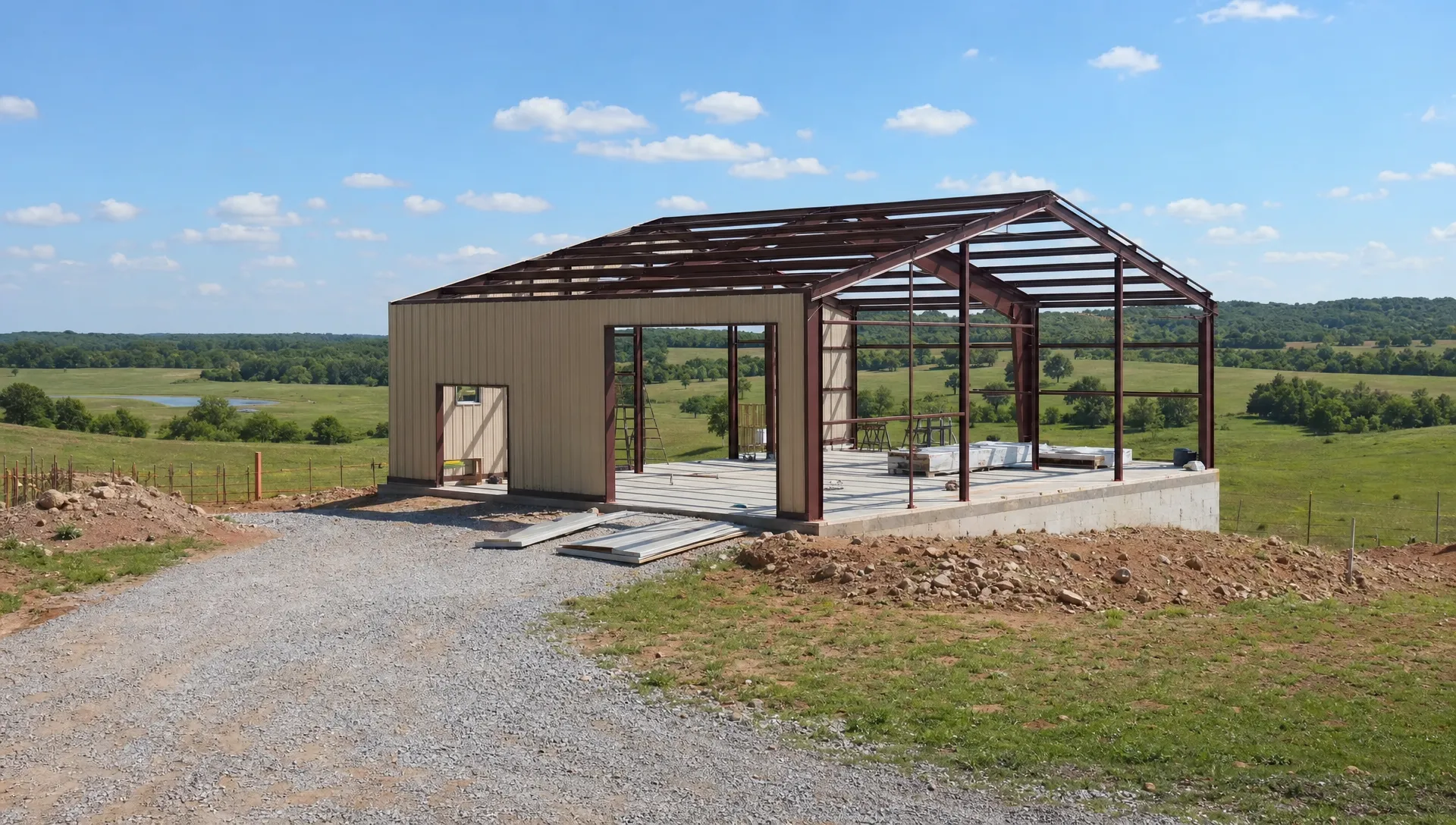
The foundation is one of the biggest differences between a basic building package and a long-lasting barndominium. Oklahoma clay soils and drainage conditions can punish shortcuts. A barndominium, shop-house, hangar, or metal building needs a foundation planned for the building loads, soil behavior, and intended use.
That does not mean every project needs the same foundation. It means the builder should be able to explain how the foundation will be planned, who provides the engineering when needed, what reinforcement approach will be used, and how the slab or foundation integrates with plumbing, porches, garage bays, shop areas, and interior walls.
Summit Barndominiums & Outdoor Living is not a standalone concrete flatwork contractor. On building projects, however, Summit’s strength is that the foundation is part of the construction plan, not an unrelated piece bolted on later. The team pours engineer-spec foundations as part of the build, including details such as rebar on chairs and foundation planning suited for Oklahoma clay soils.
For landowners comparing builders, this is an important question: is the foundation included in the building scope, and is it being coordinated by the same team responsible for the structure? If not, you may be left resolving conflicts between a slab crew, kit provider, framer, plumber, and inspector.
You can also review Summit’s guide on choosing a foundation contractor for a new build if you want to understand the foundation questions that matter before construction begins.
Decide whether you want a kit, shell, partial build, or turn-key build
Not every landowner wants the same level of service. Some people only need a shell. Others want a dried-in building and plan to finish the interior themselves. Many want a turn-key barndominium where one builder coordinates the process from foundation through finish-out.
The important part is clarity. If a proposal says shell only, know exactly what is excluded. If a proposal says turn-key, ask what that includes. A vague scope can make two bids look comparable when they are not.
| Build approach | What it typically means | What to clarify before signing |
|---|---|---|
| Customer-purchased kit | You buy a building package from a kit supplier | Who handles permits, foundation, assembly, inspections, and missing parts |
| Shell-only build | The exterior structure is built, often without full interior finish | Whether slab, insulation, windows, doors, porches, and utilities are included |
| Partial build | Builder handles selected phases while owner manages others | Who schedules trades, solves conflicts, and carries responsibility between phases |
| Turn-key build | One GC coordinates the project from foundation through finish-out | Allowances, selections, timeline, change orders, and final inspection process |
Summit does not sell prefab kits, but can install a kit the customer buys. That distinction is important. A kit is a product. A barndominium is a construction project. If you buy a kit, you still need a qualified builder to handle the real-world conditions on your land.
Ask how permits and code compliance will be handled
Permits are not just paperwork. They protect the owner, the builder, and the long-term value of the property. Depending on where your land is located, you may deal with city permits, county requirements, rural fire access, septic approvals, utility provider requirements, HOA approval, or lender documentation.
This is especially important inside city limits. Some builders avoid complex municipal processes, but Summit builds within Tulsa City limits as well as throughout surrounding communities. That experience can matter if you are building in Tulsa, Broken Arrow, Owasso, Bixby, Jenks, Sand Springs, Claremore, Collinsville, Sapulpa, Bartlesville, Skiatook, Pryor, or nearby areas.
Ask builders whether they pull required permits and how they handle inspections. Also ask how they work with architects and engineers. Summit does not create architectural or engineering drawings in-house, but works with architects and engineers as needed so the project can be designed, reviewed, and built properly.
A builder who treats permits as the owner’s problem may not be the right fit for a landowner who wants a coordinated project.
Compare bids by scope, not just total number
It is natural to compare bottom-line numbers, but a barndominium proposal is only useful if you understand what is included. A lower number may exclude foundation work, utility coordination, interior finish-out, permit handling, insulation, porches, driveway access, or site preparation. A higher number may include more complete responsibility.
Instead of asking which bid is cheapest, ask which bid is most complete for the result you want. Best value means the scope is clear, the foundation and structure are coordinated, the materials fit your goals, and the builder has the experience to finish the project correctly.
Pay close attention to allowances and exclusions. Allowances are common for items such as fixtures, cabinets, flooring, appliances, or certain finish selections. They are not automatically a problem, but they should be realistic and clearly explained. Exclusions should be just as clear. If septic, well, utility trenching, driveway work, or architectural plans are outside the builder’s scope, you need to know that early.
If you are still mapping the full sequence, this overview of how to build a barndominium in Oklahoma from start to finish can help you understand where major decisions happen.
Ask practical questions before you choose
A good builder will welcome informed questions. You are not being difficult by asking for clarity. You are protecting your land, your budget, and the finished building.
Good questions include:
- Have you built barndominiums, shop-houses, shops, garages, hangars, or metal buildings on Oklahoma land similar to mine?
- Will you visit the property before finalizing the scope?
- Who is responsible for permits and inspections?
- How is the foundation planned and engineered for the structure?
- Who coordinates plumbing, electrical, HVAC, insulation, and finish-out?
- What is excluded from the proposal?
- How are changes handled after construction begins?
- Who will be my main point of contact during the build?
Listen carefully to how the builder answers. The best builders do not need to make the project sound overly simple. They explain the process clearly, identify risks early, and help you make decisions in the right order.
Watch for red flags without assuming the worst
Most builders are not trying to mislead customers. Sometimes they simply operate in a narrower lane. A kit seller may be excellent at selling packages but not set up to manage a custom build. A shell builder may be a good fit for owners who want to self-manage the rest. A post-frame specialist may be the right choice for certain agricultural projects but not the best fit for a full custom barndominium.
The risk comes when scope is unclear. Be cautious if a builder avoids site questions, cannot explain permit responsibility, treats the foundation as separate from the structure, pressures you to sign before walking the property, or gives vague answers about who coordinates the trades.
Also be careful with overly generic designs. Your barndominium should match how you plan to live and work. A family building a shouse with RV storage has different needs than a rancher adding equipment space, a pilot planning an aircraft hangar, or a homeowner adding a detached garage with a finished area. Your builder should understand those differences.
Choose a builder who can grow with your vision
Many Oklahoma landowners build in phases. You may start with a barndominium now and add a shop, porch, outdoor kitchen, pergola, patio, garage, carport, or room addition later. A good builder will help you think about future use before the first phase is built.
That does not mean overbuilding. It means planning smart. Door placement, utility routing, rooflines, drainage, driveway access, and porch orientation can all affect future additions. If you may add an outdoor living area or shop bay later, discuss it early so the first build does not make the next one harder.
Summit’s construction division is built around that broader view. The team handles custom barndominiums, metal building framing, garages, carports, workshops, sheds, outdoor kitchens, pergolas, patios, room additions, and other structures. For landowners, that can simplify long-term planning because the same general contractor understands how the pieces fit together.
Why Summit is a strong fit for Oklahoma landowners
Summit Barndominiums & Outdoor Living is a Tulsa-based, owner-operated builder led by Alan Holcombe. The company serves Tulsa and northeast Oklahoma, including Broken Arrow, Owasso, Bixby, Jenks, Sand Springs, Claremore, Collinsville, Sapulpa, Bartlesville, Skiatook, and Pryor. Summit also builds statewide, including Oklahoma City.
The company’s positioning is simple: best value, not cheapest. Summit is a design-build construction team and general contractor for custom structures, with one point of accountability from the ground up. The team can manage projects from design coordination and foundation through finish-out, or anywhere in between based on the customer’s requested scope.
For Oklahoma barndominium projects, Summit’s rare combination is important: foundation knowledge, metal building expertise, project management, permitting, and finish construction under one coordinated build process. The result is not a generic kit dropped onto a slab. It is a custom, engineered, permitted building planned for your land and your specifications.
Frequently Asked Questions
How do I find the right barndominium builder near me in Oklahoma? Start by looking for a builder with Oklahoma land experience, not just barndominium photos. Ask whether they visit the site, pull permits, coordinate the foundation, manage trades, and understand local wind, soil, utility, and inspection requirements.
Is a barndominium kit the same as hiring a builder? No. A kit is a building package. A builder coordinates the actual construction, including foundation, permits, site conditions, assembly, utilities, and finish-out if included in the scope. Summit does not sell prefab kits, but can install a kit the customer purchases.
Why is the foundation so important for an Oklahoma barndominium? Oklahoma clay soils, drainage, building loads, and high wind conditions can all affect foundation performance. The foundation should be planned with the structure, not treated as a separate afterthought.
Can I get an exact price before a site visit? A builder may be able to discuss general budget drivers, but a responsible final scope should account for your land, access, utilities, permitting, foundation needs, and finish level. That is why an in-person consultation is so valuable.
Does Summit build inside Tulsa City limits? Yes. Summit builds within Tulsa City limits and serves the broader Tulsa and northeast Oklahoma area, while also building statewide, including Oklahoma City.
Ready to choose a builder for your land?
Your land deserves more than a generic estimate. Whether you are planning a custom barndominium, shouse, workshop, garage, carport, hangar, agricultural building, or outdoor living addition, choose a builder who can look at the full project from foundation to finish-out.
Summit Barndominiums & Outdoor Living offers free in-person consultations for Oklahoma landowners. Call or text (918) 286-7084 to talk through your property, your goals, and the right next step for your build.